|
|
From
1881 to 1903, the current
territory comprised by La Isabella was part of an area of 46,580
hectares, which belonged to different people, until as from 1898
it became property of the Banco de la provincia de Córdoba. The
current area comprising "La Isabella" ranch was established in 1898.
The buyer was a joint ownership submitted by Ramón J. Cárcano, at
that moment already retired from his important political career.
Cárcano had been a national representative of Córdoba and minister
of the government of Córdoba. As from 1890 he was devoted to the
breeding and improvement of bovine and equine cattle, and continued
his labor as historian. Some years later, from 1913 to 1916, his
office as governor of the province of Córdoba terminated. His management
was one of the most progressive, especially as regards farming politics
and improvements on roads of the province.
April 20th of 1904, he sold it to Dr. Maximiliano
Aberastury, a doctor specialized in dermatology and assistant in
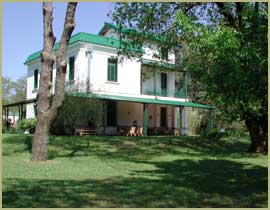
scientific publications. He is supposed to be the one who built
the first buildings of the main house of La Isabella, since the
year 1904 is inscribed in the main shed. Probably, the house of
the mayordomo (a gaucho in charge of administering the ranch) and
the ancient tower of water were built in the same year. But he was
also the owner of La Isabella for only 3 years, then he sold it.
In 1907 to Dr. Aldo Bonzi and Mauricio Andreossi. Up until
the sale the territory had no name. Dr. Aldo Bonzi was Italian,
and his partner, Mauricio Andreossi was Swiss. They were the ones
who name this noble ranch for the first time as "La Italo-Suiza".
They also were the ones who made it function. They created an important
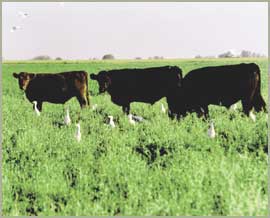
breeding of black Aberdeen Angus, they planted alfalfa and built
the main house. They bought it in Milano, Italy, and carried it
by boat to Buenos Aires, by train to Del Campillo and by ox car
to the place where it is now. They designed the park with its pictures
framed with eucalyptus which were useful to introduce the products
of the breeding. The one who operated the partnership was Dr. Aldo
Bonzi, by then single and willing to work. He gathered a group of
noble and wealthy Italians, all of them residing at Milano, Italy,
who created a financial partnership to operate the ranch Bonzi had
bought in Argentina. The partnership was created for 5 years, and
after fulfilling its purposes, it was duly liquidated. Among the
Italian investors there was a senator, two earls, a commander, a
knight and an engineer.
On December 24th of 1921, the ranch is sold to Juan Lalor,
an important agricultural producer and consignee and founder member
of the Rotary Club Buenos Aires. The camp "La Italo Suiza" was joined
to two neighboring fields and became the name of "San Eduardo" ranch.
There are photos of this period which display new works in the main
house as well as rural activities. The staff working in San Eduardo
at those times was about 50 people. The heirs of Carlos Lalor sold
it on June 17th of 1957 to Waldtraut Elisabeth Mechthild
von Bohlen und Halbach de Thomas, main shareholder of Aguas Dulces
S.A. As in Argentina nobody was able to pronounce her name, she
named the ranch "La Isabella" which is a translation of the German
name Elisabeth. Since then up to now, it has been the property of
Aguas Dulces S.A., being Mrs. B. the main shareholder and her daughter
Diana Thomas de Friz the administrator.
|